

Who Can Repair An Ancient Molokai Fish Pond
Project Loko I'a: Restoring Hawai'i's Traditional Fish Ponds
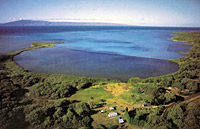
Aeriform view of Keawanui Fishpond, Molokai
On this page:
- Hawai'i fishpond history
- Reviving the by
- Dorsum to the hereafter
- For more than information
- Project Partners
Near people become to the supermarket for their seafood, increasingly, in Molokai and other parts of Hawai'i, some lucky residents can become their fish and limu (seaweed) grown from a local pond. In addition, residents in Hawai'I and on the mainland are now seeing beautiful "live rock" for sale in their local aquarium stores and can exist pleased to know that this man-made alternative is the perfect antidote to illegal coral mining.
A revival of traditional aquaculture techniques has been ongoing for several years in Hawai'i. Projection Loko I'a [pronounced Loko ee-ya] a fishpond restoration project started in 1999 with EPA aid and has yielded successful results that has assisted others in Hawai'i to brainstorm their own fishpond restoration efforts. For many Hawai'ians, fishpond restoration is seen equally an important step toward a sustainable future and a way to preserve an important part of Hawai'ian culture.
In September 2004 a statewide fishpond conference of fishpond operators was held at He'eia Fishpond, Oahu. The briefing was sponsored by Project Loko I'a and Paepae o' He'eia. Over seventy people representing fishpond operators, non-profit foundations, government officials, educators, scientists, entrepreneurs and interested community members attended the two day event.
These groups, from Molokai Hui o Kuapa, the Hawaiian Learning Middle located at Keawanui Fishpond, from Oahu, Paepae o' He'eia, and from Maui Ao'ao Na Loko I'a o Maui at Ko'ie'ie Fishpond run across themselves as a resources on their corresponding islands to assistance others who are interested in restoring fishponds.
Pinnacle of page
Hawai'i fishpond history
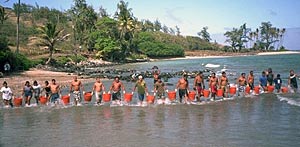
Restoring the Kahinapohaku Fishpond
In ancient Hawai'i, fishponds were an integral function of the ahupua'a, the country surface area that stretched from the mountains to the coral reefs. The Hawai'ians congenital rock-walled enclosures in near shore waters, to raise fish for their communities and families. More than 75 of these ponds were believed to accept been in production at ane time or another on the island of Molokai alone, with the latest estimates equally high as 488 statewide.
As Hawai'i agronomical system began to focus on cash crops, fishpond use declined. In some cases, the fishponds became significantly contaminated by polluted runoff from urbanization, overgrazing, and agricultural output. Information technology is estimated that up to 95% of these ponds crave some level of restoration.
Summit of page
Reviving the past
Hawai'ian communities take taken the initiative to restore the fishponds and revive aquaculture in the Country. Since October of 1999, Congress allocated over $one.4M to restore fishponds and to analyze water quality impacts, outset on the isle of Molokai.
Previously, a fishpond owner was faced with the hard journey of navigating through the many permits needed to restore a fishpond. Federal and state agencies, fishpond owners and operators, and community members have recently developed a more streamlined approach that can help the owner/operator meet the needed requirements in a more than reasonable time flow.
Project Loko I'a sought to discover or assist ascertain a lead bureau inside the Country of Hawai'i during this projection menses. However, with fewer resources available within the Land, this effort was not successful. With this in heed, organizations statewide accept started to share their experiences and information to assistance each other through the approval processes.
Top of folio
Back to the hereafter
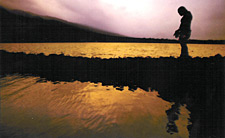
Fishponds are important to the Hawaiian culture
Thirteen fishponds have been restored statewide, with six ponds currently in use; three on Molokai, one on the island of Hawai'i, and two on Oahu. Through Project Loko I'a, the Hawai'ian Learning Heart at the Keawanui fishpond on Molokai has been established and provides the local, land, aquaculture and inquiry community an opportunity to view, hash out and experience a working fishpond and demonstration ahupa'a. The strategic plan also calls for continued education and research in fishpond direction, aquaculture, ecosystems, and h2o quality, business organisation/marketing and Hawaiian civilization.
A squad of Molokai youths have gained much from this experience, past developing business plans, learning ancient wall building techniques, identifying and working to streamline allow requirements, and monitoring the ponds water quality. Their expertise is being used to work with other communities to restore additional fishponds throughout the Land.
In addition, Keawanui is the Molokai field site for teacher training and in 2005, will exist hosting students using the Kahea Loko (Telephone call of the Fishpond) Curriculum. Project Kahea Loko is funded by the U.S. Department of Instruction and focuses on the development of culturally relevant curricula using the fishponds to teach science, social studies and language arts to students in grades iv to twelve.
For more data
View the total report and other information:
- Loko I'a Written report (PDF) (83 pp, v.6MB About PDF )
- Assay of water quality data (PDF) (42 pp, 410K About PDF )
- Fishpond regulatory permit guide (PDF) (12 pp, 68K About PDF )
- Permit forms (PDF) (ten pp, 45K Most PDF )
Top of page
Project partners
Hawaiian Learning Center
P.O. Box 486
Kaunakakai, How-do-you-do 96748
phone (808) 558-0111
Farber and Associates
2722 Ferdinand Ave.
Honolulu, Hullo 96822
phone (808) 988-3486
Dr. Rodger Babcock (babcock@wiliki.eng.hawaii.edu)
Professor of Civil and Environmental Technology
346 Holmes Hall
Univ. of Hawaii at Manoa
Honolulu Hi 96822
phone (808) 956-7298
EPA Contact
Susan Polanco de Couet (polanco.susan@epa.gov)
phone (808) 541-2722
Top of page

Source: https://19january2017snapshot.epa.gov/www3/region9/water/lokoia.html
Posted by: alexanderanceent.blogspot.com
0 Response to "Who Can Repair An Ancient Molokai Fish Pond"
Post a Comment